

Nobody thinks about their patio door until it starts to stick on them, whistle to them from the wind, or fog up between the glass panes. That’s when the patio door replacement cost ceases to be an abstract project in their head and becomes something they need to put money towards.
A quick look at the numbers will show that a full replacement generally costs around $700 to $6500, with most homeowners spending between $1,000 and $4000, and a custom build using high end materials can easily exceed $6500. Here is a breakdown of what goes into it.
If your patio door opens onto an outdoor entertaining area, explore our deck installation cost pricing guide to estimate the cost of building or upgrading a deck.
Cost By Door Style
The type of entry you choose has to determine the floor and ceiling of anything else before you start factoring in materials, labor, or accessories.
- Sliding glass doors: $1,200 to $4,000. This is the most common type of design, and for good reason: it uses sliding panels on a track instead of hinged ones. Hardware and labor are simpler.
- French doors: $600 to $4,500. A pair of hinged, swinging entry doors, which usually needs more hardware and framing than the previous, and therefore has a larger range of options. A simple design doesn’t have much more cost over a sliding glass door, but intricate detailing can push the cost right up there with the telescoping doors.
- Telescoping doors: $1,500 to $6,000. Made of multiple sliding panels that slide and stack atop one another, these are popular for larger openings which must fully open.
- Bifold doors: $5,000 to $9,000. These are made of several panels that accordion together to open, and offer the most “square footage” of any design and price accordingly.
Material And Glass Options That Affect Cost
Frame material typically represents the single most significant factor in terms of pricing.
- Vinyl: $400 to $1,200 for a full package. The most budget-friendly option that is perfect for most of the standard jobs. It will not increase the value of your house significantly, but it will also not break your wallet.
- Aluminum: $600 to $2,500. Thinner sightlines are the norm here, and aluminum is a popular choice for contemporary construction.
- Fiberglass: $800 to $3,500. This material is best known for its resistance to the ravages of the weather without the maintenance required by wood.
- Wood: $1,000 to $5,000. By far the most expensive of the standard framing materials, wooden windows are also likely to require periodic refinishing.
Custom sizes and premium brands could easily cause the cost of a single window to exceed $10,000 before installation even begins, with glass being another consideration. Double pane glass windows are the standard, and options like low E coatings, argon gas, and impact resistance add significantly to the cost from there.
To compare energy-saving features when choosing a replacement patio door, consult the U.S. Department of Energy’s guide to energy-efficient windows and doors.
What Impacts Patio Door Replacement Cost Beyond The Unit
Labor cost is usually $70 to $120 per hour, and a basic installation takes 3-5 hours. This brings the labor costs to somewhere between $210 (3 hours at $70) or $600 (5 hours at $120) for most jobs.
Some other considerations might add a few bucks to the final sum:
- Framing adjustments or a non matching door would add around $150 to $250 or more.
- The removal of the existing door costs up to $100 to $500 (depending on how it was installed and whether it bears weight).
Seeing A Quote Come Together
Here’s an example of a quote for a mid range replacement sliding vinyl door:
| Line Item | Cost |
| Vinyl sliding door, 6 ft, double pane | $1,800 |
| Labor (4 hours at $95/hr) | $380 |
| Old door removal and haul-away | $200 |
| Total | $2,380 |
That’s a great quote, but the job isn’t always as simple as stated. Imagine that the installer shows up, removes the old unit, and discovers that the sill located underneath had rotted away due to water intrusion through a plugged weep hole. That’s a pretty common scenario, and it adds another $300 to $800 for sill replacement, and additional labor.
The same $2,380 job can land closer to $3,200 once that’s factored in. That’s why two different contractors can tell you very different numbers for the exact same job, based on their assumptions about the condition of your old framing.
Repairing One Item Rather Than The Entire Door
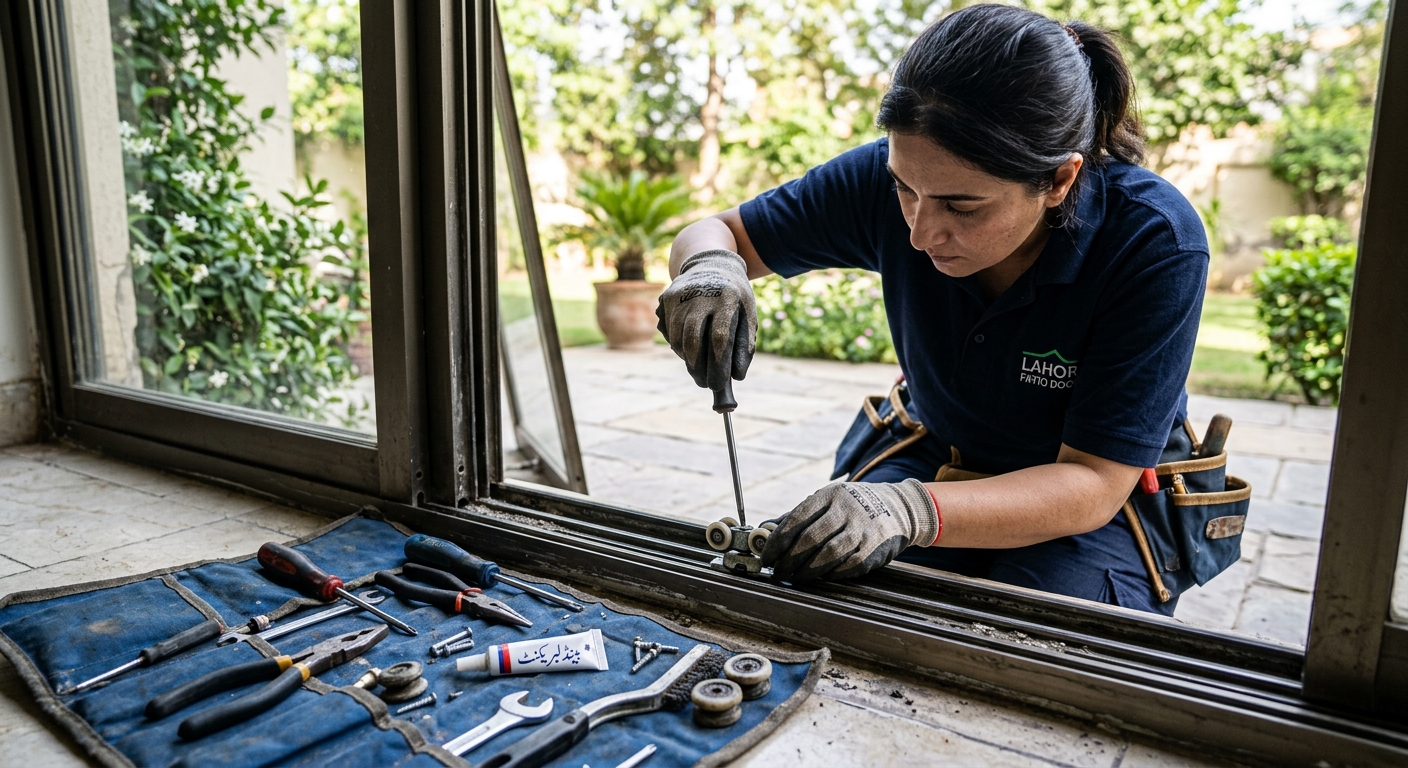
Sometimes the frame itself is fine and only one component has failed. Repair costs are far from full replacement cost:
- Glass replacement: $300 to $700
- Single panel replacement: $400 to $900
- Screen replacement: $150 to $400
- Rollers and tracks: $100 to $300
Ask before a replacement quote if a repair is an option at all. For a door with a solid frame and one failed roller or a cracked pane, it’s usually the cheaper option by a wide margin.
Extra Costs That Might Come Up
Rot around the sill or water damage in the framing doesn’t show up until the old door is gone, which is a time and material delay. Upgraded hardware is another common add on, multi point locks run $200 to $700 depending on how many locking points the door has.
Permit requirements vary block to block, if you are changing the size of the opening it’s worth a call to your local building department before work begins, not after.
If your door replacement is part of a larger interior renovation, read our baseboard installation cost guide to estimate the cost of installing or replacing interior trim.
Frequently Asked Questions
- How much does patio door replacement cost?
A complete replacement of the patio door, including hardware usually costs $700 to $6,500, with most homeowners only spending $1,000 and $4,000. The material you choose, as well as an increase or decrease of the size of the opening, is the primary factor that affects the cost of the replacement.
- What is the cheapest type of material for a patio door?
Vinyl is the most affordable material for a patio door, with the full set of replacements, including hardware only costing $400 to $1,200. However, it is also the least desirable option from the point of view of increasing the resale value of the house, so installing a vinyl patio door only makes sense if you have plans to move out.
- How long does it take to replace a patio door?
Overall, replacing a patio door is a quick procedure that only takes 3 to 5 hours. However, if reinforcing the existing frame or adjusting the size of the opening is required, the job may already take more than one day.
- Is it cheaper to repair or replace a patio door?
Unless the frame has sustained serious damage, it is almost always cheaper and quicker to repair a patio door rather than replace it. Fixing one of the panels or the rollers, for example, would only take a couple of hours.
- Do I need a permit to replace a patio door?
Getting the required permit depends on the specific regulations in the area. In general, however, if the size of the opening is not planned to be changed, a permit is usually not necessary. If you do want to increase the size of the patio door, contact your local authorities and ask your contractor to request an on-site inspection.
- Can I replace a sliding patio door with a French door?
In most cases, you can, but your contractor will have to reinforce the frame because of the different mechanisms required for French doors. Always get a detailed estimate of the costs involved before you finalize the plans since the reinforcement of the frame could add significantly to the cost.
- Is it worth it to spend more on energy efficient glass?
In most cases, yes. The additional costs are usually compensated by the money saved on utility bills, and the doors with energy efficient glass also tend to increase the value of the house during an appraisal.
Conclusion
In the end, patio door replacement cost is determined by the style selected, the materials and glass options that are chosen, and the amount of labor that is needed to complete the job. This shouldn’t be a guessing game when it comes to the cost if you can see the information.
Request multiple quotes in writing and ask about what each includes, and be prepared to ask about a total that doesn’t seem to add up. It’s also a good sign if the contractor provides an itemized detailed list as a way to show you exactly what they will do and how much it will be. This shows that they know what the job entails and aren’t going to try to cover up the cost with an incomplete job.
