
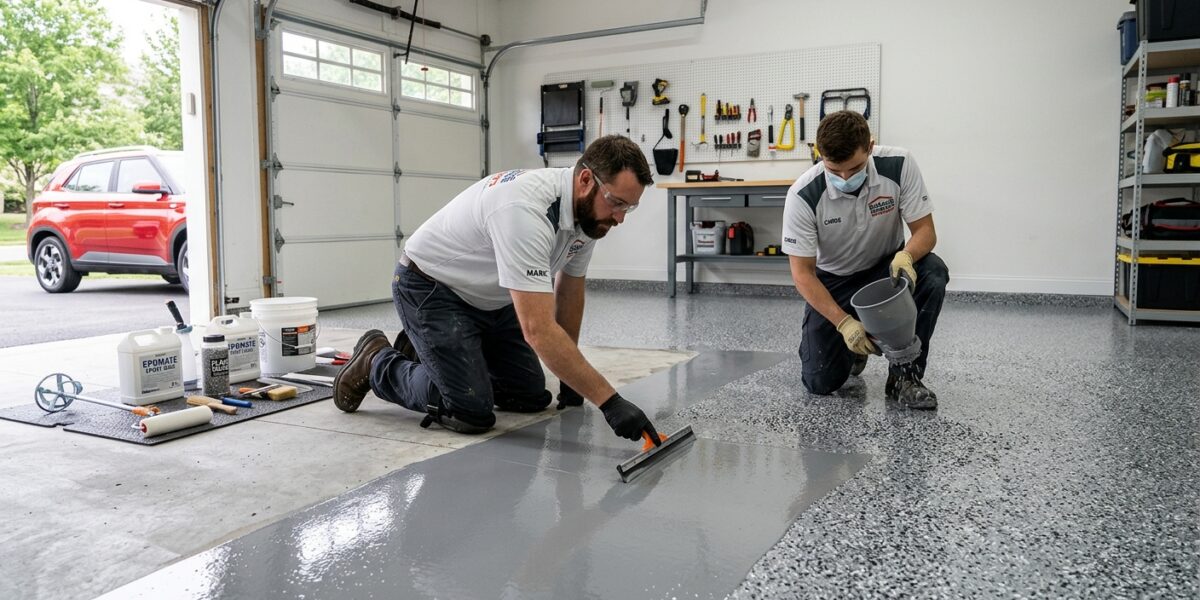
If you’re in the market for a new floor, you’ve probably noticed that there’s no clean “average price per square foot” answer. Ask 5 contractors and you’ll get 5 different numbers, all of which are correct, just quoting different jobs.
The price per square foot is determined by the coating system, the condition of your concrete, how much grinding it requires for prep, the labor rate in your city, and how finished you want it to look.
As a rough estimate, professional epoxy flooring cost roughly $6 to $15 per square foot in 2026. If you’re not afraid to roll up your sleeves, epoxy kit materials only cost roughly $1 to $5 per square foot.
In reality this means a 500 square foot garage floor costs around $3,000 to $7,500 for a professional contractor or less than $1,500 in materials if you’re willing to do the labor on your weekend. Now that we’ve established a ballpark we’ll move on to talking about where your money goes.
If you’re also considering traditional wood flooring, explore our hardwood flooring cost pricing guide to compare the costs of another flooring option.
What Actually Drives the Price Per Square Foot
Contractors aren’t making up numbers willy nilly, there are a few factors which have a strong bearing on the price of a square foot in epoxy.
- Floor size. Larger jobs cost less per square foot, because the costs of equipment, travel, permits, and other fixed costs get divided across the square footage. Smaller jobs or rooms sometimes get priced with a minimum square footage fee.
- Condition of the concrete. This is what most homeowners greatly underestimate, pitted concrete, oil soaked spots, hairline cracks, and failed coatings all result in more time spent grinding, degreasing, and patching the concrete before epoxy can even be applied.
- Coating system and thickness. The base price of a solid color is different from a metallic system with a built up appearance, commercial floors also often need a thicker build to withstand forklifts and heavy traffic.
- Labor and region. Labor can be as much as $2 to $7 of the square footage, and differs wildly depending on the region and demand for contractors.
If you’re comparing flooring options for your home, read this vinyl plank flooring installation cost guide to explore the installation costs of another popular flooring material.
Average Epoxy Flooring Cost by Coating Type
Different materials carry different prices, these are a rough estimate of installed prices for the various types of coating in 2026.
- Water based epoxy: $3-$7 per square foot
- Solvent based epoxy: $4-$9 per square foot
- 100% solids epoxy: $5-$12 per square foot
- Flake epoxy: $5-$10 per square foot
- Metallic epoxy: $8-$15 per square foot
- Premium decorative systems: $10-$18+ per square foot
It’s important to treat these as a guideline, you should always request an itemized quote from any contractor you’re considering, because these prices are broken down by job item and it’s the only way to make comparisons across contractors.
Real World Pricing Examples
While ranges are helpful, seeing them applied to real world garage and shop sizes makes budgeting much easier.
- One car garage (~300 sq ft): roughly $1,800 to $4,500 installed
- Two car garage (400-500 sq ft): about $2,400 to $7,500, depending on repair and finish
- Three car garage (600-750 sq ft): typically $3,600 to $11,250
- Small commercial space (1,000-2,000 sq ft): usually $6,000 to $18,000
- Large industrial floor (5,000+ sq ft): often drops to $3 to $6 per square foot
That same 500 square foot garage falls around $3,000 to $7,500 before any repair costs get added in. Which brings us onto our next topic
Building Your Own Estimate
Most contractor quotes use a rough calculation of square footage price square footage. So a 500 square foot garage at $8 per square foot comes to $4,000 before repairs, moisture treatments, and other things get added in.
If you’re rolling up your sleeves and doing a DIY install, budget for the kit, any equipment you need to rent, and any materials like tape and rollers before adding in 10% for waste because you’ll have to mix more epoxy than you end up using.
What a Full Labor Quote Should Actually Cover
Before signing anything, make sure the quote includes everything. Protecting the area, grinding and degreasing, crack repair, primer work, mixing and applying the epoxy, broadcasting any flake, laying a top coat, and cleaning up the job site.
This is important, because you may find that a cheaper bid has fewer coats than a higher bid or uses a thinner system which impacts the price.
The Costs Most Guides Don’t Mention
Older concrete tends to surprise a lot of homeowners. Moisture under the slab can be one of the biggest expenses you’ll run into, because it renders a lot of epoxies unusable, until a moisture barrier is added.
Some things worth budgeting for are:
- Grinder rental: $75-$200 per day
- Crack repair compound: $30-$150
- Moisture vapor testing
- Removing and disposing of an old coating
- Contingency for surprises
A general rule of thumb is to leave 10-15% of your budget for unforeseen circumstances or expenses, you’ll likely need it.
Before beginning a flooring renovation, review the EPA’s guide to indoor air quality during home remodeling for advice on managing dust and indoor pollutants.
DIY or Hire a Pro
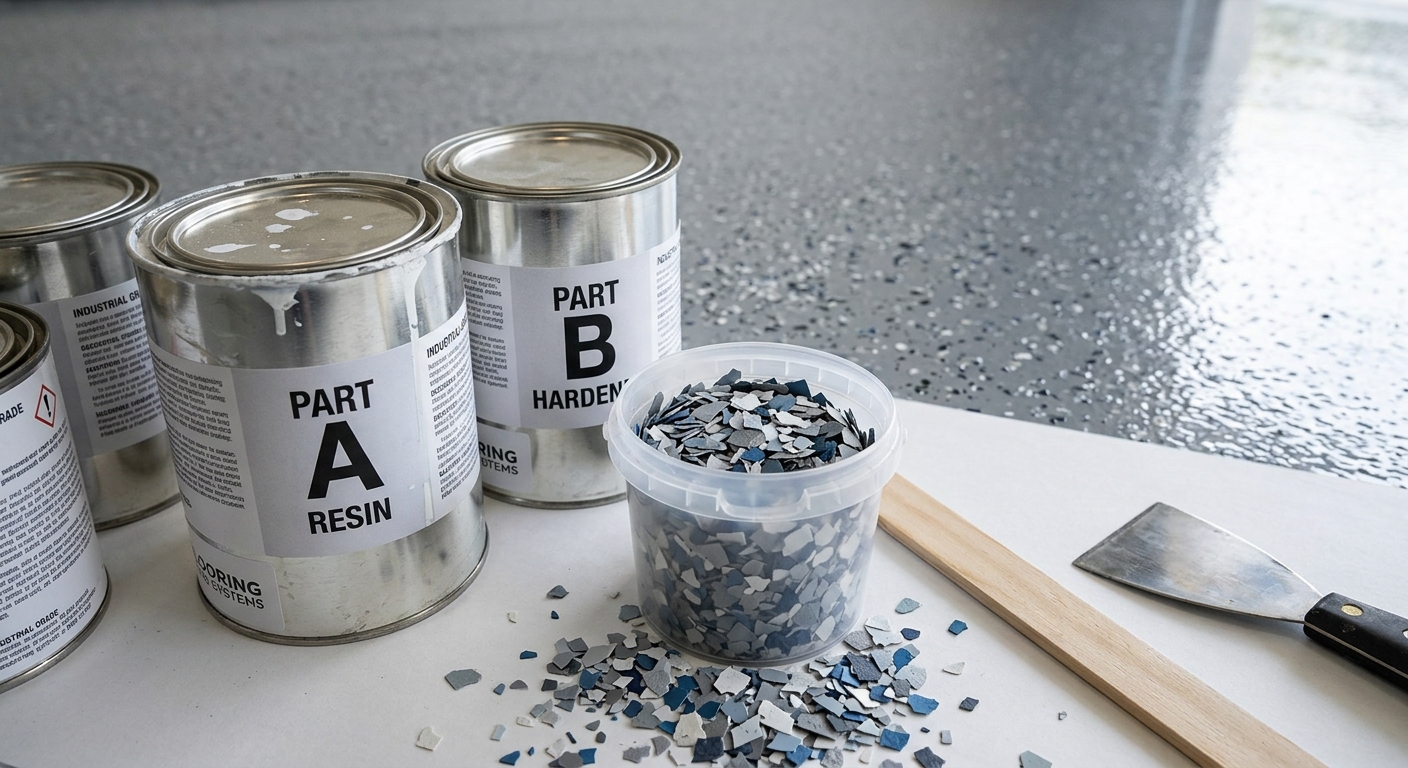
Material only kits run about $1 to $5 per square foot and you can save as much as 70% by doing the labor yourself. However, the 70% you save comes at the expense of time, equipment rental, and the possibility of mistakes showing up in the finished product weeks or years down the line.
Water based paint coatings tend to have poor performance, and can be especially problematic on a hot driveway during the summer, a proper 100% solid epoxy with a urethane top coat has superior performance and durability.
Generally speaking, it’s best to hire a professional for older concrete, larger spaces, and wherever there is regular traffic. If you have a small garage, and decent condition concrete, a DIY kit can be a viable solution for a weekend project.
Questions Worth Asking Before You Hire Anyone
Don’t be fooled by the cheapest options when shopping around as a customer, ask what’s included in their quote, do they do the surface prep, crack repair, primer, color coat, flake, top coat, cleanup, and a warranty or are some of those extra?
Ask what type of epoxy is being used (100% solids or waterbased) and how much the finished product will be built up, and if they’ll check for moisture before working. It’s a good idea to get at least three estimates, so you understand exactly why some are higher than others.
Is Paying More Actually Worth It
A cheap floor that fails in two years more often than not costs more than a well installed floor that lasts 10-15 years, think in terms of cost per year of enjoyment and the math changes dramatically.
Moisture testing before installation is cheap insurance, it protects against delamination and prolongs the life of the system as a whole.
If you have existing hardwood floors that need attention, read our hardwood floor refinishing cost guide to learn about refinishing costs.
Frequently Asked Questions
- What’s the average epoxy flooring cost per square foot?
Professional installation typically runs $6 to $15 per square foot. If you’re doing it yourself with a materials only kit, expect $1 to $5 per square foot.
- How much does it cost to epoxy a two car garage?
For a 400-500 square foot garage, budget somewhere around $2,400 to $7,500 professionally installed, depending on how much repair work is needed and the finish you choose.
- Is DIY epoxy actually cheaper?
Yes, often by a lot up to 70% less than hiring a pro. Just remember you’re still on the hook for equipment rental and repair materials, and mistakes during prep can cost you more later.
- What pushes the price higher than expected?
Bad concrete condition, a heavier duty coating, decorative flake, a specialty finish, moisture problems, or a job site that’s hard to access all add cost.
- How long does a properly installed epoxy floor actually last?
With good prep and professional installation 10-15 years or more is typical. Traffic levels and how well you maintain it after the fact matter too.
- Does epoxy resist hot tire peeling?
A high grade 100% solid epoxy with a urethane top coat holds up well against it. Water based paint coatings, by contrast, tend to bubble and peel within a few years.
- Can you epoxy over cracked concrete?
Not without repairing the cracks first. Skipping this step is one of the most common reasons garage floor coatings fail early.
Bottom Line
Epoxy flooring cost is driven by more than just a price per square foot, floor size, concrete condition, coating type, labor, and finish all factor in. For most homes, $6 to $15 per square foot is a realistic range for professional installation, though you’ll want an on site inspection before locking in a firm quote.
DIY material kits generally stay in the $1 to $5 per square foot range. Whatever route you take, get itemized estimates and make sure you’re comparing the same scope of work across contractors. In almost every case, proper surface prep pays for itself a lot more reliably than chasing the lowest bid on the page.
