Circuit Breaker Replacement Cost Guide And Pricing Details
Short answer
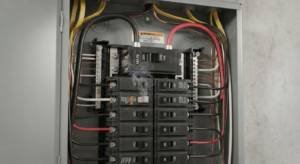
A standard circuit breaker replacement typically falls between $100 and $260, labor included. Breaker type and amperage, part availability, the panel's brand, age and accessibility, code compliance and permits move the price. A main breaker replacement typically costs $200 to $600, and a full 200 amp panel replacement $2,500 to $3,000.
Cost at a glance
| Project Type | Typical Cost |
|---|---|
| Standard breaker replacement | $100 to $260 |
| New breaker installation | $150 to $300 |
| Main breaker replacement | $200 to $600+ |
| Entire 200 amp panel replacement | $2,500 to $3,000 |
| Transitioning from fuse box to breaker box | $1,100 to $4,000 |
See the full breakdown below · Estimates, not quotes.
Circuit Breaker Replacement Costs Explained For Homeowners
A breaker that does not stop tripping, refuses to reset, or feels warm when touched isn't something to overlook but it needs a professional look. It is important to know that the circuit breaker replacement costs ahead of time and it makes it easier to budget and to tell whether a quote is fair or lined with extras you don't actually need.
Most homeowners find $100 and $260 for a standard job, but it depends on the breaker type, the amperage, the condition of your panel, local labor rates, and on the electrician's expertise.
Average Cost
After installation, a single pole breaker (15 to 100 amps) usually runs 100 - 180 dollars. Step up to a double pole breaker (50 to 200 amps) and you're looking at 180 - 260 dollars. Buying and installing a brand new breaker land between 150 - 300 dollars.
| Project Type | Typical Cost |
|---|---|
| Standard breaker replacement | $100 to $260 |
| New breaker installation | $150 to $300 |
| Main breaker replacement | $200 to $600+ |
| Entire 200 amp panel replacement | $2,500 to $3,000 |
| Transitioning from fuse box to breaker box | $1,100 to $4,000 |
Main Breaker And Panel Replacement Costs
A main breaker swap alone runs $200 - $600 or more and it often can't start until the utility company disconnects service, which adds coordination time on top of the labor itself. A full 200 amp panel replacement typically lies between $2,500 - $3,000, with the final number depending on the condition of the existing wiring and how much labor the job demands. See electrical panel replacement cost for prices by amperage.
The parts rarely drive the price up, for example standard breaker costs $5 to $50, and AFCI or GFCI models, the ones built with extra fire and shock protection run $20 to $150. The bulk of what you pay covers the electrician's time, not the hardware.
What Affects Circuit Breaker Replacement Cost
Small quantities can push the final bill higher or lower than the baseline range.
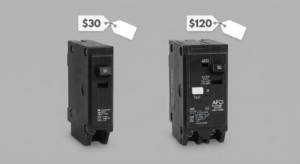
- Breaker type and amperage Single pole breaker is cheaper than an AFCI or GFCI unit, and many current building codes now require those safety models.
- Part availability Older panel brands sometimes use discontinued breakers, and tracking one down can cost 2 - 3 times more than a common replacement.
- Panel brand and age Panels from Federal Pacific Electric or Zinsco carry known safety concerns, so an electrician may recommend a fuller evaluation before touching anything.
- Code compliance If your panel predates current electrical code, bringing it up to standard can mean extra parts, extra labor, or both.
- Panel accessibility Obstructed panels requiring furniture removal or drywall cutting will incur extra time.
- Permits and inspections Bigger jobs involving wiring changes may call for a permit ($75 to $150) and a follow up inspection ($100 to $250).
Labor Rates And Diagnostic Fees
Expect to pay $50 to $130 an hour for an electrician, along with a charge of $75 to $200 for just coming to the house and looking at the problem prior to making any repairs.
And that diagnosis step matters more than people think. If a breaker repeatedly trips, replacing it won’t solve the problem if the problem is actually circuit overload, faulty wiring, a short circuit, ground fault, or even a dying appliance.
Circuit Breaker Replacement Versus A New Circuit Or Panel
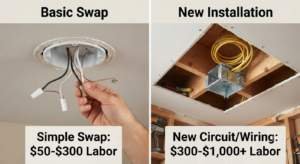
Replacing a faulty breaker is a much smaller job than adding a brand new circuit. A straightforward replacement is nothing fancy. Unhook the old unit, install a suitable replacement in its place, test it, and your job is done.
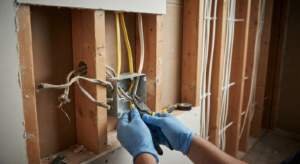
Installation of a new circuit requires laying of new wiring to an electrical outlet or appliance, and may require cutting into walls or different floors. In most cases, replacing a single breaker costs less than replacing the whole panel.
If your panel is reasonably modern and in decent shape, fixing the one faulty breaker is usually all it takes. Serious rust and pitting, cracked or burned bus bars, an aging setup, or electrical trouble that keeps coming back are usually a sign you're better off upgrading than patching things.
Signs You Need A Circuit Breaker Replacement
A breaker tripping by itself doesn't automatically mean it's bad, but a few warning signs are worth taking seriously:
- Even a normal load can cause tripping.
- It is too hot to the touch, or it cannot remain in the ON position.
- You can smell something burning or find scorch marks around the panel.
- There is a flicker in the lights, buzzing in the outlets, or some disturbance in electricity.
- You do not hear a clicking sound when you turn it on.
- Your panel is an older Federal Pacific Electric or Zinsco model.
Most breakers last 15 to 20 plus years, but any hint of burning or scorching should be treated as urgent, not something to wait on.
Why Professional Installation Matters
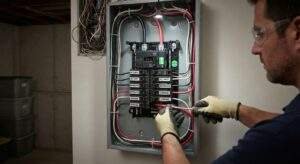
Breaker work means dealing with high voltage power, and live terminals stay inside the panel even after the main is switched off. A licensed electrician knows how to do his job to lower the faulty wiring, bad grounding, or violations down the road.
How To Save On Replacement Costs
Collect at least 3 written estimates before committing pricing fluctuations a lot by region and company. Check that each quote explains labor, materials, service fees, and testing. Ask whether the diagnostic fee gets credited toward the final bill, and whether bundling multiple breaker replacements into a single visit brings the per-unit price down.
Go with an electrician who actually got experience, not just whoever gave you the cheapest quote, and don't pick a breaker based on price either. It must be appropriate to your panel and rated appropriately for the circuit that it is intended to protect.
Conclusion
It is much simpler to differentiate a small fix from a large scale project when the circuit breaker replacement cost is estimated at the very beginning, as it will save you from unexpected expenses such as diagnostic costs, upgrades, or panel prices.
A standard swap is usually around $100 to $260, while main breakers, harder to find parts, permits, and panel repairs can push the total higher. Get a few quotes, confirm exactly what IS included in each, and if you notice burning smells, constant tripping, or a breaker that won't reset, call a licensed electrician to keep your home safe and up to code.
Frequently asked questions
What is the average circuit breaker replacement cost?
It typically falls between $100 and $260 for a standard job, labor included.
How long does circuit breaker replacement take?
A typical job usually takes somewhere between 30 minutes and two hours, not including any time spent diagnosing the issue first.
Why does my breaker keep tripping after replacement?
Usually it's not the breaker at all, more likely an overloaded circuit, a short, or an appliance that's on its way out.
Can I replace a circuit breaker myself?
Technically yes, but electricians advise against it because of the shock risk, and also a professional inspection after the work.
Does a main breaker cost more to replace?
Yes, main breaker replacement typically costs $200 to $600 since it controls the entire panel and may require coordinating with the utility company.
Will homeowner's insurance cover a breaker replacement?
Not usually for ordinary wear and tear, but damage from a power surge or a lightning strike could be covered.
When should I replace the whole electrical panel instead of one breaker?
If the panel's badly outdated, corroded, or overloaded, you're better off getting a full evaluation than just swapping out one part.
More electrical cost guides

Next step
Get an itemized quote for your electrical project
A vetted local pro from our network prices the job. Compare it against the ranges in this guide. Free, no obligation.